Digitizing historic collections has been a core throughline of my professional career. In my first internship, I spent a summer in the archives at the Historical Society of Pennsylvania transcribing nineteenth century files of Philadelphia’s earliest orphanage. For two years, I worked at the James A. Michener Art Museum and coordinated object photography and cleaned up their collections database. The fact that today, the public can now access a database with high-quality photography of the diverse collection at the Michener is something I am proud to know is out there and accessible. The same goes for the now digitized materials that make up the Lena Allen-Shore Papers of Gratz College. The fact that many of the letters, photographs and other materials I processed are now digitized means that more students and the public can engage with her incredible life and body of work.
In both these jobs, my day-to-day was a behind the scenes look at beautiful paintings, sculptures and inspiring poetry. The work that I did in both these roles broke down barriers to access when it came to encountering items in historic collections. These digital facsimiles are nonetheless a great starting point for interacting with a museum or archives’ collection.
Our readings for this week, complicated my understanding of digitization and digital files in the archive. S.L. Ziegler asked the big question of, “are we better than data brokers?” in an essay for the Digital Humanities Quarterly.1 She reminds us that we need to be cognizant of ethical issues when handling historic sensitive data.
Ziegler’s point resonated with me in the responsibilities that are involved with being a historian in the modern age. In my first opportunity for transcribing documents at the Historical Society of Pennsylvania, the orphanage records detailed children’s names, ages, and any known family members. All this would be considered historically sensitive data. The purpose of my transcription was to provide this genealogical information for the historical society’s database so that it could be a resource for the institution’s members and genealogical researchers.
Not only do I agree with Ziegler that we should pause and reflect on how we consider historical data; I believe we should also evaluate our use of technology when it comes to research methods. Historian Dan Cohen gave some insights into how A.I. can “diminish some of the monotony of research, perhaps we can spend more time thinking, writing, playing piano, and taking walks — with other people.”2 While Cohen does make a good point that using language learning models can allow us some more flexibility when it comes to research, I am not ready to give transcribing duties solely to A.I. without some checks and balances.
Prior to engaging with A.I in this course, I had a lot of ethical baggage and skepticism. Even though Cohen showed that A.I. tools can transcribe things relatively accurately, he still reviewed the material and compared it to his original transcriptions. When I worked with Transkribus I found a lot of glaring flaws. In class on Monday, I uploaded a copy of this letter written by William “Buffalo Bill” Cody to the Commissioner of Indian Affairs. I chose this letter because it featured nineteenth-century cursive handwriting and it was a source that was related to Native American history. You can see in the image below there are a couple of errors, but I will point out some of the glaring ones. In the header, the A.I. missed the “C” of District of Columbia. In the second line of the body text of the letter, it transcribed Fort Yates as “Port Yates” but transcribed it correctly further in the paragraph. These inconsistencies in the transcription surprised me after seeing how Cohen used Gemini to decipher George Boole’s letter, which also contained cursive handwriting.
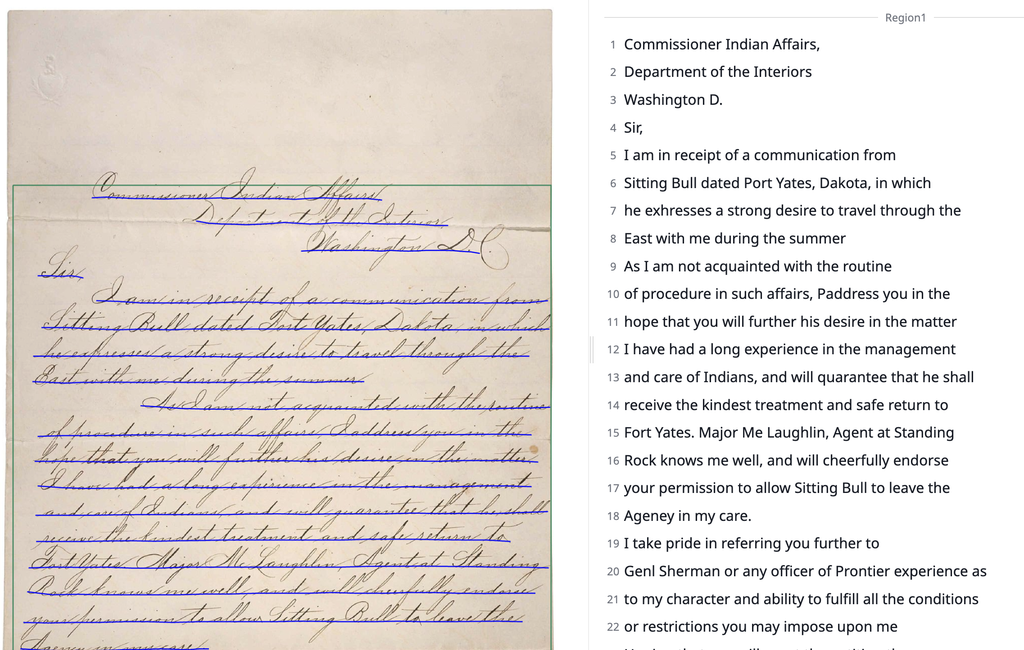
Image of a letter with A.I. transcription on the right
After that, I tried something more challenging for the A.I. to transcribe, which may have been setting it up for failure in the first place. Over the summer, I combed through the letter indexes of the Bureau of Indian Affairs, each letter was given a specific ID number. To research this collection in the future, I had to manually add all these ID numbers into a spreadsheet so I could put in a research request for these specific letters. These indexes contained hundreds of letters from the Lincoln Institute in Philadelphia, a federal Indian Boarding School that was the subject of my master’s Thesis. Transkibus’ transcription came out horrible; it clearly had difficulty distinguishing the numbers. It may be difficult to see in the image below, but when looking at the record side-by-side with the transcription, you can see that the A.I. missed or misrepresented many ID numbers when making its transcription.
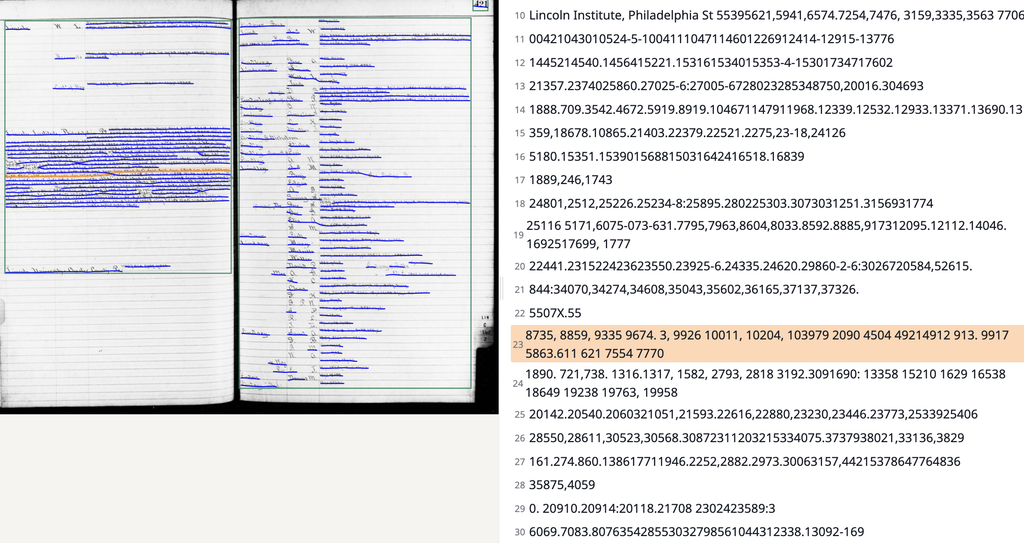
Image of a notebook with AI transcriptions next to it on the right
In 1990, Dr. Lena Allen-Shore wrote in her book, The Ten Steps in the Land of Life, “We live in a time when borders are abolished, communication is instant through technology, but we have to ask ourselves, do we know how to communicate with each other while retaining respect for every person on earth?” 3While over thirty years old now, this ethical insight from Dr. Allen-Shore still rings true in our modern times, not just in how we communicate with others but how we use technology to communicate with each other and share our research. Like Cohen’s newsletter, I would encourage historians interested in transcriptions to use new trends in technology with care and attention to detail. I firmly believe there still needs to be human checks and balances to these tools so as not to let errors pervade in our research and the historical record. I also hope that with some of the links I provided in this piece you can see some of the incredible works of art in the Michener’s collection and learn more about the life of Dr. Lena Allen Shore. I believe looking at art and reading poetry can not only make us better historians, but more well-rounded people.
1 S.L. Ziegler, “Open Data in Cultural Heritage Institutions: Can We Be Better Than Data Brokers?” Digital Humanities Quarterly, Vol. 14, No. 12, accessed September 1, 2026 https://doi.org/10.63744/jfyb9zym5am3
2 Dan Cohen, “The Writing is on the Wall for Handwriting Recognition,” Humane Ingenuity, date published November 25, 2025, date accessed September 1, 2026 https://newsletter.dancohen.org/archive/the-writing-is-on-the-wall-for-handwriting-recognition/.
3 Lena Allen-Shore, “Preface to the Third Edition,” in The Ten Steps in the Land of Life: A Step-by-Step Guide to Meaning and Happiness in Life, Third Edition. (Lena Allen-Shore Center, 1990) 8.
Hi Lena, definitely agree with the need for checks and balances in the use of AI for any purpose, even beyond the scope of history. Already we’ve seen exploits of local chatbots which hijack agentic or semi-agentic systems to do something counter to what the creator indended by hiding LLM instructions among downloaded files. I’m interested though — did you try Claude or Gemini for the files Transkribus did poorly with? I’m curious how they would do for something like this; I suspect the answer would be probably better for the first and still not very well for the second, but I was wondering if you tried putting either of those through an LLM.
Hi Maddie, that is a good point I did not think to use Claude or Gemini for these transcriptions as a comparison during class, I was so focused on analyzing the details of where Transkribus messed up. Especially as the Cohen piece mentioned he used Gemini and received a much more accurate transcription, I will have to do so and let you know if they came out any better comparatively!
Hi Lena, it was great to learn a bit about your background with transcription and public collections work! The project you worked on at the Historical Society of Pennsylvania archive sounds particularly interesting (my research has largely been on social reform work in the United States), and I would love to learn more.
I thought your response to Ziegler’s article was very thoughtful, and it seems like we both had similar ethical quandaries with making personal records and information accessible. Is it possible to both make historical information accessible and protect individuals’ privacy? Considering how hungry data brokers are, I am doubtful. However, there are still various types of historical, artistic, and cultural material that do not contain personal information and can be appropriately shared with the public. Court cases and orphanage records—to the historian’s dismay—are not included in that category.