Clio Blog Week 4 Digital Exhibits and Copyright
As I’ve referenced in numerous blogs this semester, I have a strong public history background working on both physical and digital public history exhibits. Many of the ideas we discussed in our readings, particularly copyright, are relevant not just for working within digital exhibits, but also for collections management. In some of my roles at public-facing institutions there were copyright policies, including agreements signed by artists that allowed the museum to use images of art for social media. This was an important thing to consider as we were building out the new publicly accessed collections database. To me, looking into copyright before including images in a public-facing work is part of the due diligence of being a public-facing historian, just like citing your sources in your work. Our readings this week provided resources from Mason’s library for looking into this further and the debate on whether published works should be open access.1 While I do not think that all works should be open access, digital exhibits are a great example of making history accessible to a wider audience. Further examining the evolution of the exhibit The Valley of Shadow: Two Communities in the American Civil War shows how digital exhibits became more accessible, which only fosters further engagement with the historical research and argument of the exhibit.
The history of the Valley of Shadow project is almost as interesting as the historical artifacts and transcriptions available within the database itself. Adam Crymble used the original Valley of the Shadow project as a key example of the impact of what historians can do when they work within digital history. In the thirty years since the project’s inception, the site evolved dramatically. One of the biggest changes occurred when the site was redesigned by Journey Group developers, “the primary sources, such as the letters, diaries, and newspapers, could now be accessed as open-source information.”2 Comparing the same letter from the latest version of the Valley of Shadow project to an archived version of the site, illustrates how far we’ve come in sharing research digitally.
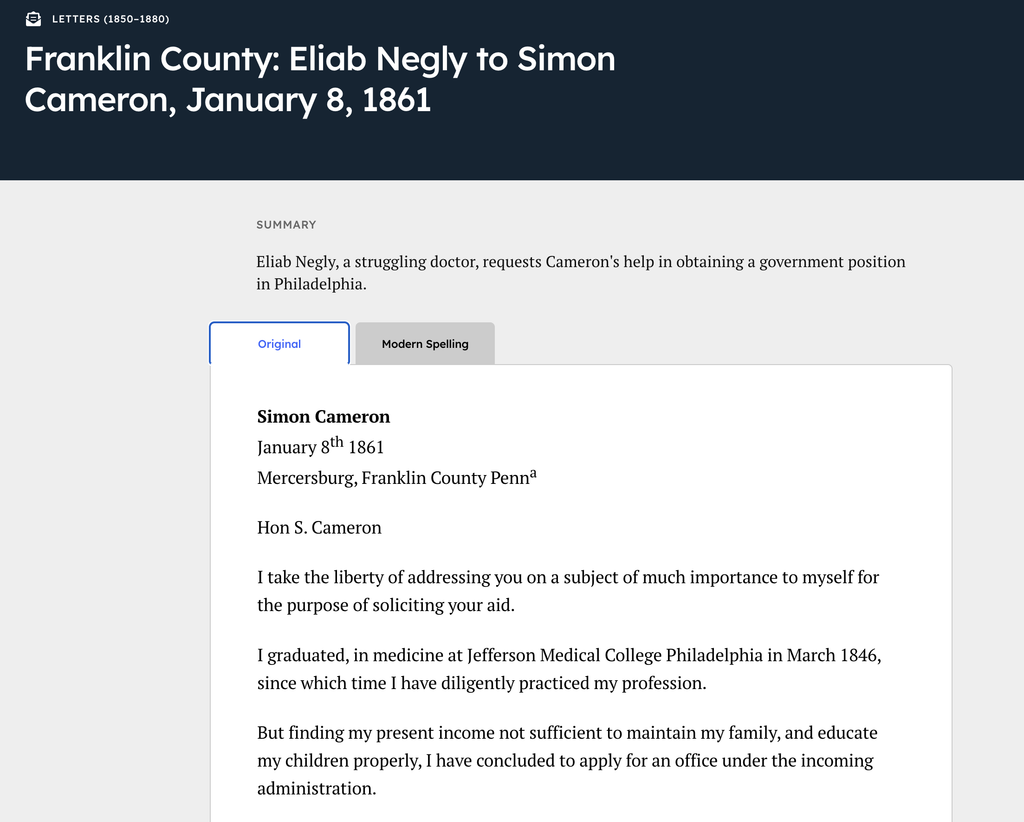
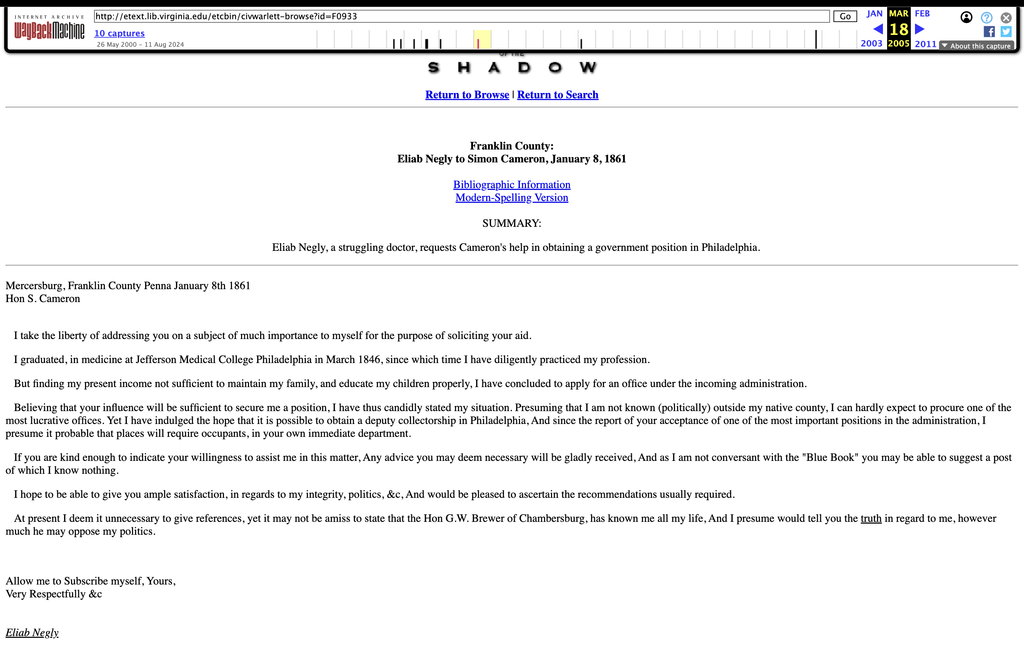
This is letter written by Eliab Negly to Simon Cameron, Cameron was the Secretary of War in 1861 from Maytown, PA.3 In January of 1861, Negly, a practicing doctor in Philadelphia, wrote to him in hopes of securing a federal job as a deputy collector in Philadelphia. The first accessible aspect I hope you will be able to notice through these screenshots is how much easier it is to read the transcription in the latest version of Valley of the Shadow compared to the 2005 version. The text is so much bigger, there are both the original spelling version of the transcription and one that includes modern spelling, and the display allows you to distinguish the letter from the rest of the site as it’s in a white text box. In contrast, the same letter in the 2005 version contains smaller sized text; everything about the website is white, and you would have to click on the modern spelling transcription instead of easily switching back and forth between them.
According to Crymble, Valley of the Shadow “became one of the first substantial historical invented archives on the Internet.”4 Through the modifications made the website’s interface over time, it has remained an even more accessible source for these resources. Crymble also described how Valley of the Shadow connected disparate resources from two distinct communities into a centralized digital space. It is emblematic of the kind of inspiring and engaging things we can do with the technological tools that power digital history. In 2009, Ayers wrote of the impact of Valley of the Shadow in the way it compiled millions of archival resources into a digital space. He warned, “The challenge now is to find meaning, coherence, and pattern in that abundance.”5 That search for meaning is up to as we engage with digital exhibits to not just understand the technology behind their creation, but also to critically engage with the historical sources and argument of the exhibit.
1 GMU Library Resources, “Copyright Basics” accessed September 22, 2026. https://infoguides.gmu.edu/copyrightbasics/begin, Nick Shockey and Jonathan Eisen, “Open Accessed Explained” video published June 2015, accessed September 22, 2026. http://legacy.openaccessweek.org/video/open-access-explained-1
2 “History of the Project” The Valley of Shadow: Two Communities in the American Civil War, accessed September 22, 2026. https://valley.newamericanhistory.org/about/history- project
3 For letter: Eliab Negly to Simon Cameron, January 8, 1861, digitized as part of Valley of the Shadow: Two Communities in the American Civil War, accessed September 22, 2026 https://valley.newamericanhistory.org/letters/F0933 For more on Simon Cameron: Jeremy Boone, “Simon Cameron,” Pennsylvania Center for the Book, accessed September 22, 2026. https://pabook.libraries.psu.edu/literary-cultural-heritage-map-pa/bios/cameron__simon
4 Adam Crymble, Technology and the Historian: Transformations in the Digital Age, (University of Illinois Press, 2021), 58-59.
5 Edward L. Ayers, “Lincoln’s America 2.0” The Journal of American History Vol. 96, No. 2 (Sep. 2009), 441, accessed September 22, 2026. https://www.jstor.org/stable/25622301
Lena,
I find that your perspective on open access as being a case-by-case situation, but digital exhibits, as you mentioned, should be open access all the time. As public historians we have a special opportunity to be able to reach our audiences more than ever and I do not see any reason to lock up our history work, which is ultimately created to educate others.
Lena – your analysis of the creation and development of the Valley of Shadow digital project is fantastic; I appreciate the extra work you put into it! It’s helpful to see both the stylistic and substantive changes that were made over time, which made it easier to find and absorb the information (i.e. size of lettering, color contrasts, modern spelling). I do have a question about sustainability with sites that are more complicated and involve more unique features. I’ve seen RRCHNM create contemporary sites with older interfaces that may be less engaging but are more sustainable on the technological side. I would be interested in hearing your experience as a public historian on this question.
Lena, I like that you connect your own work experience with what we are learning in class. In my part-time work for a museum, I make short educational videos, and sometimes it takes a lot of time just to find public domain images, music, and footage for a one-minute educational video. That is why I believe students and historians should have easier access to educational and historical resources without having to go through complicated and expensive copyright procedures.
Hi Lena,
I totally get the headache of dealing with copyright in a museum/gallery setting. I was always surprised by how many artists didn’t understand that the gallery needed permission to use their work for promotional material. Your breakdown of Valley of the Shadow is really helpful. Having it laid out like that is a great way to see how the site connects to all the themes we’ve been discussing in class.