Insights from the readings in the Pedagogy module stress the importance of integrating digital tools within the humanities and in the classroom. For instance, Clarie Batterhill and Shawna Ross remark in Using Digital History in the Classroom that “Because digital technologies are increasingly central to the way we do our work as humanists, we all have a responsibility to keep pace with the information.”1 Some of the other readings in this module provide key examples that reveal insights into how digital history tools enhance a student’s learning experience.
Learning about how Kalani Craig and her colleagues used digital tools to allow students to connect to the lived experiences of plague victims in medieval Constantinople was emblematic of the benefits of digital history in the classroom. For an activity, students tracked their location on campus, and Craig plotted that data on a map of Constantinople to show students how easily a plague spread in a medieval space within a familiar setting. Craig argues in summary that, “Digital tools effectively supported improvement in student understanding of historical context, and these learning gains were more pronounced for groups who showed sustained discussion in both science reasoning and historical thinking.”2 Instead of hearing only a lecture on medieval history, students were able to connect and engage with primary sources and the lived experiences of individuals to better grasp the historical context at hand.
Dr. Otis’ own work reveals the strengths of professors engaging with digital tools, like Wikipedia, in ways that provide skills of a historian. She argues in “Constructing and Contesting the Past: Teaching in the Age of Wikipedia” that “Incorporating Wikipedia into the classroom, whether in small or large ways, can strengthen students’ digital literacy skills, their understanding of historiography and historical sources, and their ability to conduct historical research.”3 Her insights in this article showcased how looking at the editing history of a Wikipedia article engages with histiorography, and how students can do primary source research finding citations for articles in their research interest that do not have citations. It really added to my perspective of implementing digital tools in the classroom.
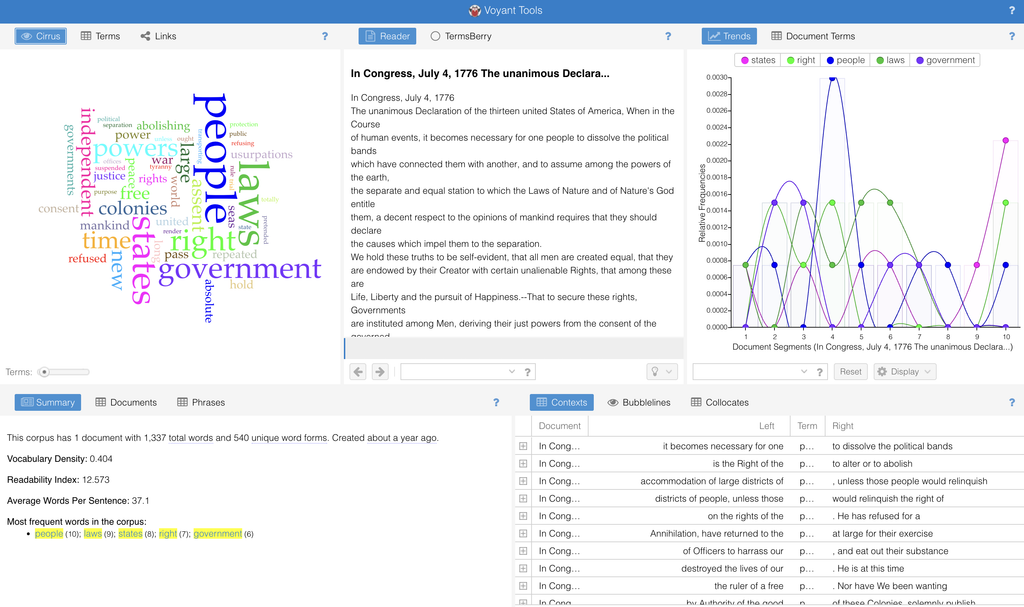
For the technical activities, I used Voyant to analyze a transcription of the Declaration of the Independence, and simply seeing the repeated phrases and other visual data sparked ideas for ways students could interact with the material and the bigger ideas at play within the primary source. For instance, Voyant produced a word cloud based on the frequency of words used within a document. One of the most repeated words within the Declaration is “people” The frequency of the phrase could instigate discussions on the exclusions embedded in the Declaration, what Jefferson defined as “the people” specifically excluded Native Americans and enslaved Africans for instance. See the screenshot below that features the Voyant word cloud and other analysis.
I also looked at a couple Zooniverse transcription projects, one of them Irish Weather Rescue features digitized historic records of rainfall data from Irish provinces in a collection held by Met Eireann (Irish Weather Service). Students could comb through this data and add to the crowdsource transcriptions on this site. They could also take a subset of this data and use tools like QGIS to trace change over time by implementing this rainfall data over an interactive map of Ireland. This way students could use digital tools to trace big ideas like change over time in a visual medium and analyze primary sources. Another transcription project I uncovered was Print, a crowdsource transcription project for 18th century letters. Using this project students could attempt to do historic transcription, and in a lesson, we could compare the student transcriptions to an A.I. model one and compare and contrast them.
Overall, I really enjoyed experimenting with different digital tools and thinking about how they can be used in the classroom. It’s a method I might considering implementing as part of my Teaching Assistant duties next time I have a review session with my students to put what I’ve read about in practice, because as these readings illustrate it can really have a positive effect on students.
1 Claire Battershill and Shawna Ross, Using Digital Humanities in the Classroom: A Practical Introduction for Teachers, Lecturers and Students (Bloomsbury Academic, 2017),11.
2 Kalani Craig, et al., “Correcting for Presentism in Student Reading of Historical Accounts Through Digital-History Methodologies,” (2017).
3 Jessica Marie Otis, “Constructing and Contesting the Past: Teaching in the Age of Wikipedia,” in Digital Pedagogy in Early Modern Studies, New Technologies in Medieval and Renaissance Studies Series, ed. by Andrea Silva and Scott Schofield, New Technologies in Medieval and Renaissance Studies, vol. 10, ed. by William R. Bowen and Raymond G. Siemens (Iter and the University of Chicago Press, March 2024):89.